Rubber track tension and maintenance: checks, intervals, replacement signs
In our article on why tracks tear we covered what kills rubber tracks. Now the practical part: how the tensioning mechanism works, how to measure sag correctly, what to inspect daily versus monthly, and how to tell a track that needs a repair from one that has reached the end of its service life.
How the tensioner works
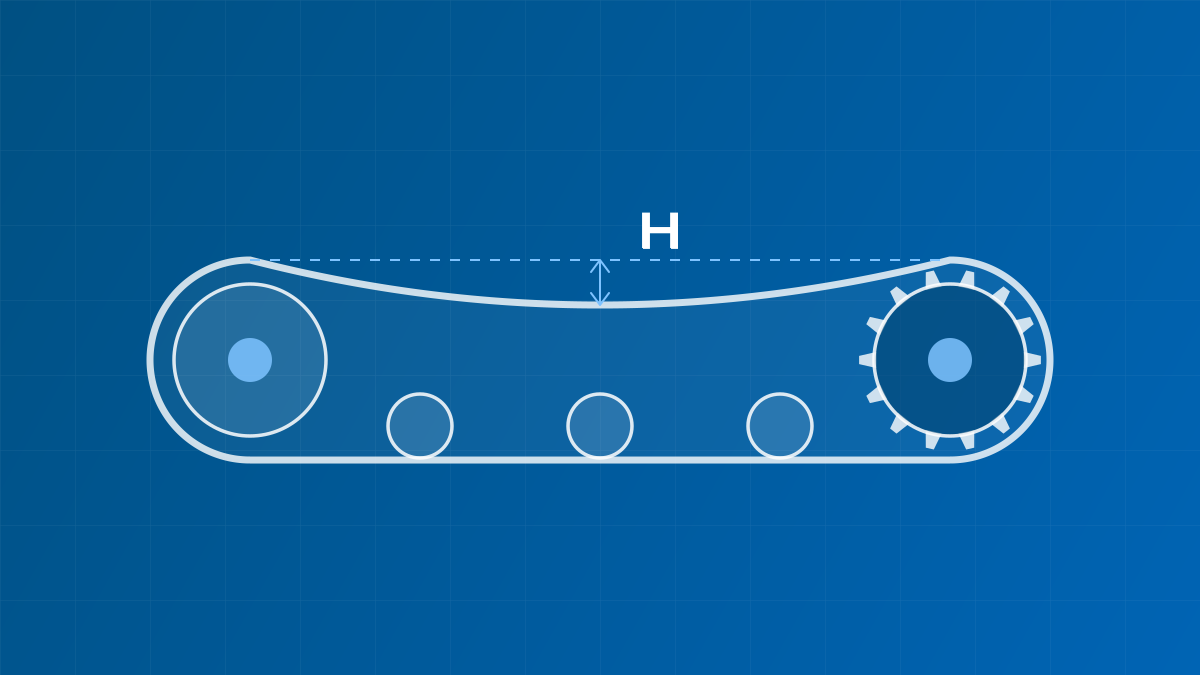
On most compact tracked machines tension is set by a grease cylinder: grease is pumped through a fitting with a grease gun, the piston extends and pushes the idler out — the track tightens. To slacken the track, grease is bled off by carefully backing out the relief valve.
Safety first: the grease in the cylinder is under high pressure, so any work on the tensioner must follow the procedure in your machine's operator's manual — on tensioning matters it is the authoritative document. The ground rules never change: engine off, controls locked out, safety glasses on; back the valve out slowly and a little at a time, within what the manual allows; keep your face and hands away from the fitting, and never unscrew the valve completely.
How to measure the sag
- Park the machine on firm, level ground and clean the undercarriage: packed clay distorts the reading.
- If the manual prescribes measuring with one side raised, lift the machine exactly as it requires and always set it on rated axle stands: never work near an undercarriage held up only by a jack or the work equipment. On some machines sag is measured without lifting — on the bottom run between the rollers.
- Measure the sag at the point your manual specifies: on most compact machines it's the gap between the bottom edge of the middle roller and the track's inner running surface.
- Compare with the manufacturer's spec. It differs between classes of compact machinery — from roughly 10 to 50 mm — so the exact value comes only from your machine's manual.
Measure with the undercarriage in its working state — the one the machine actually runs in, not right after its once-a-year deep clean.
Over- and under-tension: spotting them without a ruler
- Over-tensioned: the track is drum-tight, the machine loses tractive effort, steering gets heavier, the inserts and rollers are noticeably hot after a shift, and idler and bearing wear accelerates.
- Under-tensioned: visible sag, knocking in the undercarriage, sprocket teeth skipping under load, the track wandering sideways with a risk of detracking in a turn or on a slope.
Both states shorten track life — we covered the failure mechanics in detail in the article on why tracks tear.
Tightening and loosening
- Remove the tensioner access cover on the track frame.
- To tighten — pump grease in through the fitting, checking the sag after every few strokes.
- To loosen — slowly back out the relief valve a little at a time, within what the manual allows, let the excess grease escape, then retighten the valve.
- Drive a few metres back and forth and re-measure: tension stabilises after movement.
Two important signals. If reaching normal tension takes the cylinder's piston to the end of its stroke, the adjustment reserve is gone — and that's a reason to have the whole undercarriage diagnosed: track stretch, wear of the sprocket, rollers or idler, and a fault in the tensioner itself all show up this way. Find the cause before ordering a new track. If the grease won't hold and tension drops within hours, the problem is definitely the tensioner (cylinder seals, valve), not the track — start with repairing it.
Maintenance intervals
- Daily, before start-up: a quick walk-around — cuts, torn lugs, wire or rebar caught in the undercarriage, condition of the track edges.
- End of shift: clean clay and stones out of the undercarriage, especially before frost.
- Weekly, roughly every 50 engine hours: measure the sag; additionally after moving to a different soil type or a sharp change in weather.
- Monthly: a full undercarriage inspection — sprocket, rollers, idler, tensioner condition and stroke.
- Before long-term storage: wash, inspect, park out of direct sun; for storage beyond a few weeks it's worth slackening the tension.
These figures are approximate: the manual and your actual conditions set the real intervals — on abrasive ground, check more often.
Inspect the undercarriage, not just the track
A new track on a worn undercarriage won't live long. During the monthly inspection watch three things:
- Sprocket: compare the tooth profile with a new one — sharpened, “sawn” teeth cut through the track's rubber bridges.
- Rollers and idler: they must spin freely, without play or oil traces from under the seals; a seized roller grinds away the inner running surface.
- Wear marks on the track: one-sided wear of the inner running surface or edges points to undercarriage geometry problems — replacing the track alone won't help there.
Signs the track is due for replacement
- exposed or rusty steel cord anywhere on the track;
- through-cracks in the carcass reaching the cord along a large part of the circumference;
- lugs torn off or worn flat over a noticeable part of the loop;
- smashed or deformed inserts, or inserts that are working loose;
- the track skipping on the sprocket even at correct tension;
- the tensioner at the end of its stroke with the sag still above spec.
Repair or replace
Local tread cuts that don't reach the cord can be repaired by vulcanising — and the earlier the better: an open cut lets moisture through to the cord, and corrosion does the rest. Damaged load-bearing cord, smashed inserts and full-perimeter rubber cracking, by contrast, call for replacing the track, not repairing it: the integrity of the load-bearing carcass cannot be restored by a repair. If a track is on its last legs, planning the replacement for a convenient pause in the work is far more rational than stopping a site over a snapped track at the height of the season.
Quick interval cheat sheet
- Daily — inspection; end of shift — undercarriage cleaning.
- Weekly — sag measurement per the manual.
- Monthly — full check: sprocket, rollers, idler, tensioner.
- Tensioner at the end of its stroke — diagnose the undercarriage and, most likely, replace the track.
- Repair cuts immediately; exposed cord means replace, not repair.
When replacement time comes, use our step-by-step selection guide for your machine model or send the old track's marking to our manager: we'll suggest compatible sizes and the right series for your working conditions. How to read the marking — in our guide to picking a track by its marking.